Llapi on alert: Four matches, four losses — time to look inward

FC Llapi has made the worst possible start to the season. Four matches, four losses and not a single point. A record that cannot be ignored and, even less so, explained solely by external factors. This is a team that invested during the transfer window, brought in quality footballers and created

FC Llapi has made the worst possible start to the season.
Four matches, four losses and not a single point. A record that cannot be ignored and, even less so, explained solely by external factors.
This is a team that invested during the transfer window, brought in quality footballers and created considerable expectations. But in football, names on paper do not bring points. They have to be turned into a functional team, with ideas, organization and balance.
And this is exactly where Llapi’s main problem appears to lie.
The problems are not just about the results
Losing one match can happen. Even two losses may have different explanations. But when a team loses four times in a row, we are no longer dealing solely with bad luck or isolated incidents.
The cause must be found.
Llapi is showing problems with its organization of play, the team’s stability and, above all, its defensive phase. Goals conceded too easily, spaces left open for the opposition and a lack of response at decisive moments are symptoms that cannot be ignored.
A team with ambitions cannot build results if every mistake at the back almost immediately turns into a goal.
When responsibility also falls to the coaching staff
It is clear that the players are responsible for what happens on the pitch. But it is equally clear that responsibility does not end there.
Given the squad Llapi has at its disposal, it is legitimate to ask: is this team being made to perform to its full potential?
Is there a clear idea of how to play? Have the right formation and balance been found? Are the defensive mechanisms working? And above all, is the team identity expected after such an active transfer window being built?
These are questions the club’s leaders and coaching staff must ask themselves.
Refereeing must not become an alibi
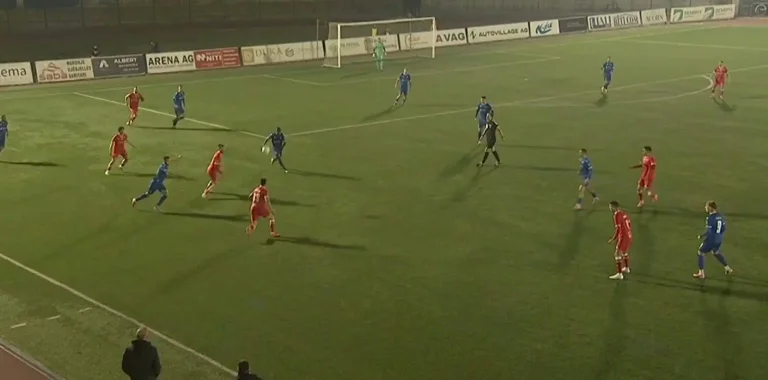
After today’s match, attention has also shifted to the referees.
Of course, refereeing can be discussed, and every incorrect decision should be analyzed seriously. But criticizing a particular decision is one thing; building an argument that a team’s results are the consequence of refereeing is quite another.
Based on what was seen in the television broadcast, general accusations against the refereeing do not seem convincing enough to explain the crisis Llapi is facing.
Even if there were decisions open to debate, they cannot conceal the problems the team is showing in its play.
Last season’s words must be replaced with work
At the end of last season, Llapi coach and executive Tahir Batatina declared that “you will never see Llapi in the relegation playoff again”.
It was an ambitious statement, in line with the expectations and objectives the club had for the new season.
But football has a simple rule: words are quickly forgotten, while results remain.
Today, after four losses in four matches, perhaps it is time to set the big statements aside and focus all the energy on work. Because objectives are not defended with statements, but with organization, commitment and results on the pitch.
Llapi still has time to turn things around, but that will require a real response.
The season is still long, and four matches do not determine the fate of a championship.
But four losses are a strong warning sign.
Now is the time for Llapi to respond. Not through statements, not by looking for culprits outside the club, but by calmly analyzing what is happening on the pitch.
Because, ultimately, football has no mercy for alibis.
When a team has invested in the transfer market, has quality players and yet comes away from four matches with zero points, the first question should be: what is not working for us?
The answer to this question is far more important than any debate with the referees.
Llapi does not need to convince anyone that it has a good team on paper.
It must prove it on the pitch.
And to do that, it must start with itself.