Argentinean media dedicates an article to Granit Xhaka: A reflection of an eternal connection with Kosovo
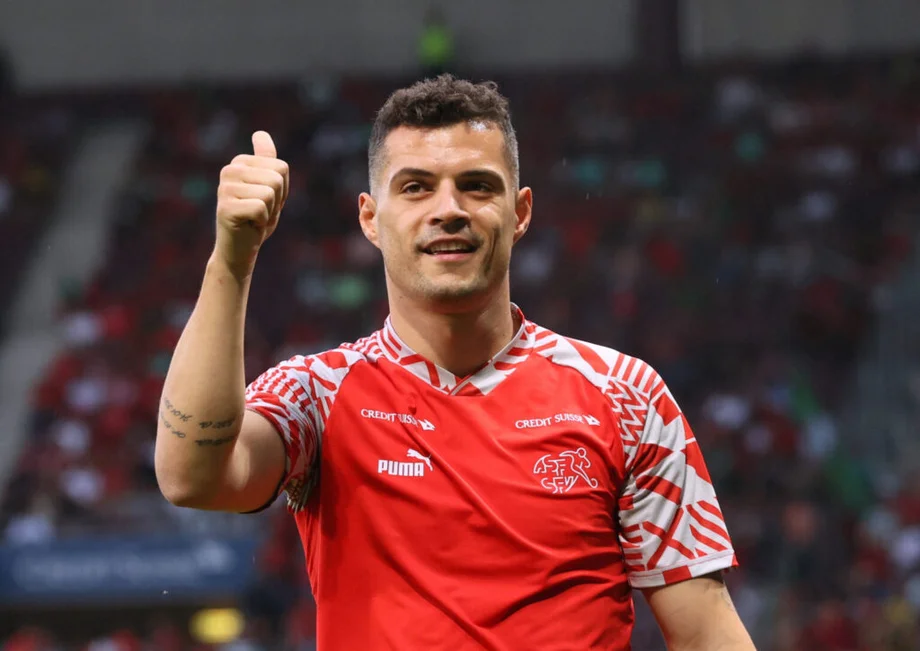
Switzerland, led by captain Granit Xhaka, has once again shown strong character by securing a place in the World Cup quarterfinals. Ahead of the clash between Switzerland and Argentina at this stage of the tournament, Argentine outlet Canal26 has dedicated a special article to Granit Xhaka, recounting his family history,

Switzerland, led by captain Granit Xhaka, has once again shown strong character by securing a place in the World Cup quarterfinals.
Ahead of the clash between Switzerland and Argentina at this stage of the tournament, Argentine outlet Canal26 has dedicated a special article to Granit Xhaka, recounting his family history, his parents’ emigration from Kosovo, and the rivalry with Serbia.
“Granit Xhaka is not only the captain of the Swiss national team or one of Europe’s best-known midfielders. He is also a reflection of a family history marked by emigration, political persecution, and an identity that has always remained connected to Kosovo,” the article says.
“Ahead of the match between Switzerland and Argentina in the 2026 World Cup quarterfinals, Xhaka’s name is once again in the spotlight, not only for his leadership on the pitch, but also for what he represents off it.”
The article begins its account with the story of Granit’s father, Ragip Xhaka, who left Kosovo after political and ethnic tensions in the former Yugoslavia.
“In his youth, Ragip took part in student demonstrations against the Yugoslav-Serbian regime and was arrested. According to European media, he was sentenced to several years in prison for taking part in those protests.”
“The prison sentence left deep scars on the family. Ragip spent years in very harsh conditions, sharing a cell with other prisoners and getting only a few minutes of fresh air each day.”
“In various interviews, he has said that he was beaten and tortured while in prison, an experience that later became part of his son’s identity.”
According to the Argentine outlet, this story of resistance, suffering, and survival explains much of Granit Xhaka’s character, whose temperament is often mentioned, alongside his discipline and ability to lead.
The article then focuses on Granit Xhaka’s birth in Basel and the sacrifices made by his parents, Ragip and Elmaze, to give their children a better life.
“His mother, Elmaze Xhaka, played an important role. She worked for a long time alongside Ragip to support the family and provide their children with a better life.”
“Granit has said in interviews that he learned to be responsible as a child. While his parents worked, he and his brother Taulant Xhaka spent many hours alone at home.”
“This difficult childhood shaped the footballer who would later become Switzerland’s captain.”
Next, Canal26 also focuses on Kosovo-Serbia relations and the historical weight of matches against the latter, especially for players of Kosovar origin.
“The rivalry between Switzerland and Serbia cannot be explained by football alone. For players such as Granit Xhaka and Xherdan Shaqiri, both of Kosovar Albanian origin, matches against Serbia carry a powerful emotional and historical weight.”
“Kosovo declared independence in 2008, but Serbia still does not recognize it. The most famous moment took place at the 2018 World Cup in Russia.”
“Switzerland beat Serbia 2-1, and Xhaka scored a decisive goal. During his celebration, he made the double-headed eagle symbol with his hands, which is associated with the Albanian flag. Xherdan Shaqiri made the same gesture.”
According to the outlet, for many Albanians and Kosovars the gesture was an expression of pride and identity, while part of Serbian public opinion regarded it as a provocation.
They write that the double-headed eagle transcends football and that the moment became one of the most powerful images of the 2018 World Cup.
“The double-headed eagle gesture became one of the most powerful images of the 2018 World Cup.”
“In sporting terms, it was a goal celebration, but historically it was an expression of identity. Xhaka was not celebrating only the goal; he was remembering his family’s origins and the history they carried. The double-headed eagle is the symbol on the Albanian flag and is widely used by the Albanian diaspora.”
“For Kosovo Albanian communities across Europe, it represents memory, pride, and cultural resilience.”
“Therefore, whenever Xhaka faces Serbia, he is seen not only as a Swiss midfielder, but as a symbol of an emigrant family and of a generation that, although born far from Kosovo, never forgot its roots.”
Finally, the article also highlights the upcoming challenge against Argentina, emphasizing the importance of the match for both national teams, but especially for Xhaka.
“For Switzerland, qualifying for the semifinals would be a historic achievement. For Argentina, the reigning world champions, the objective is to defend the title. And for Granit Xhaka, this is another opportunity to show that his career has been built on major challenges, maximum pressure, and a personal history that has always driven him to fight to the very end.”
“Granit Xhaka is much more than Switzerland’s captain. He is the son of parents who emigrated from Kosovo, the heir to a painful family memory, and one of the most important figures in a multicultural national team that has transformed its roots into a footballing identity.”